Shirley Erwee
Shirley Erwee
How Families Break the Poverty Mindset
Why do some families build stability, opportunity and generational wealth while others remain trapped in cycles of financial struggle for decades?
This question sits at the centre of generational poverty and financial mindset research, yet it is often avoided because it touches on uncomfortable truths about responsibility, behaviour and family structure.
Research from the Brookings Institution, a Washington think tank, highlights that upward mobility is not determined only by external circumstances such as education systems, politics or economic conditions. While these factors do matter, the research repeatedly points to two personal influences on long-term financial outcomes:
1. work ethic
2. family stability
These factors are not popular, but they are vital to understanding how poverty cycles are formed and how they can be broken.
The tendency to avoid these discussions prevents people from recognising patterns that could change the trajectory of their lives.
Once people understand the patterns that tend to produce stability and prosperity, they are empowered to make different choices.
The Lie of Powerlessness in Generational Poverty
Modern culture often teaches people to interpret their circumstances primarily through the lens of victimhood.
There are, of course, real and significant hardships. Many people face serious obstacles including poor education, absent parents, addiction, crime, economic instability and generational disadvantage. These realities should never be dismissed or minimised.
However, there is a critical difference between acknowledging difficulty and teaching people that they are powerless within it.
One mindset says:
“My circumstances influence me, but I still have agency.”
The other says:
“My future is determined entirely by forces outside my control.”
The second mindset erodes initiative, responsibility and resilience.
In contrast, families who break cycles of poverty often do so at the point where someone makes a different decision ... a decision to act with discipline rather than impulse, to choose commitment rather than instability. Someone chooses long-term thinking rather than immediate gratification.
That decision does not instantly create wealth, but it can change the direction of a family line.
Wealth Begins in the Mind, Not the Bank Account:
Understanding the Poverty Mindset
Financial outcomes are not shaped only by income or opportunity. They are also shaped by beliefs formed long before adulthood.
Many parents unknowingly pass down limiting beliefs about money to their children, such as:
“People like us never get ahead.”
“Rich people are greedy.”
“Money always disappears.”
“Business is too risky.”
“You need a job to be secure.”
“Wanting wealth is selfish.”
These messages are usually not taught directly. They are absorbed through tone, stress, avoidance, anxiety and everyday conversation.
Children raised in environments where money is associated with fear, shame or helplessness often carry those emotional associations into adulthood.
This is why financial education must go deeper than budgeting or saving strategies. True transformation begins with mindset, because mindset determines behaviour.
Why Family Structure Matters
Stable families create far more than emotional security. They create environments where children develop consistency, discipline, accountability and long-term thinking.
Children raised in stable homes are generally more likely to:
Complete their education
Avoid crime and high-risk behaviour
Develop stronger emotional regulation
Build healthier relationships
Achieve greater financial stability as adults
This is not a judgment on single parents or families who have experienced disruption. Many individuals overcome extremely difficult circumstances and achieve remarkable outcomes.
However, it is also unhelpful to pretend that family structure has no influence at all. Read what the economic research shows in my article: Marriage, the Overlooked Wealth Factor
Stable families remain one of the strongest foundations for long-term social and economic mobility.
Breaking Generational Poverty Patterns in Families
Breaking the Cycle of Generational Poverty
Many parents recognise recurring financial patterns in their own upbringing, such as:
Chronic debt
Fear around money
Financial secrecy
Dependence on credit
Hopelessness or resignation
Conflict around finances
Lack of initiative
The encouraging reality is that these patterns are not fixed.
You can interrupt the negative patterns through small, consistent changes in how your family speaks, thinks and behaves around money over time. New habits, reinforced daily, gradually reshape the financial future of a family.
In time, your children will even call out lapses into your old thinking patterns! They'll learn to recognise them!
Restoring Agency in Financial Mindset

Real compassion does not tell people they are trapped forever.
It restores agency.
Agency is the belief that while you may not choose your starting point, you can influence your direction.
Your choices matter.
Your habits matter.
Your family culture matters.
Your thinking matters.
Your future is not fixed.
That message can feel uncomfortable, but it is brings fresh hope, because what can be influenced can also be changed...and where agency is restored, change becomes possible.
Identifying Inherited Beliefs in The Roots of Wealth
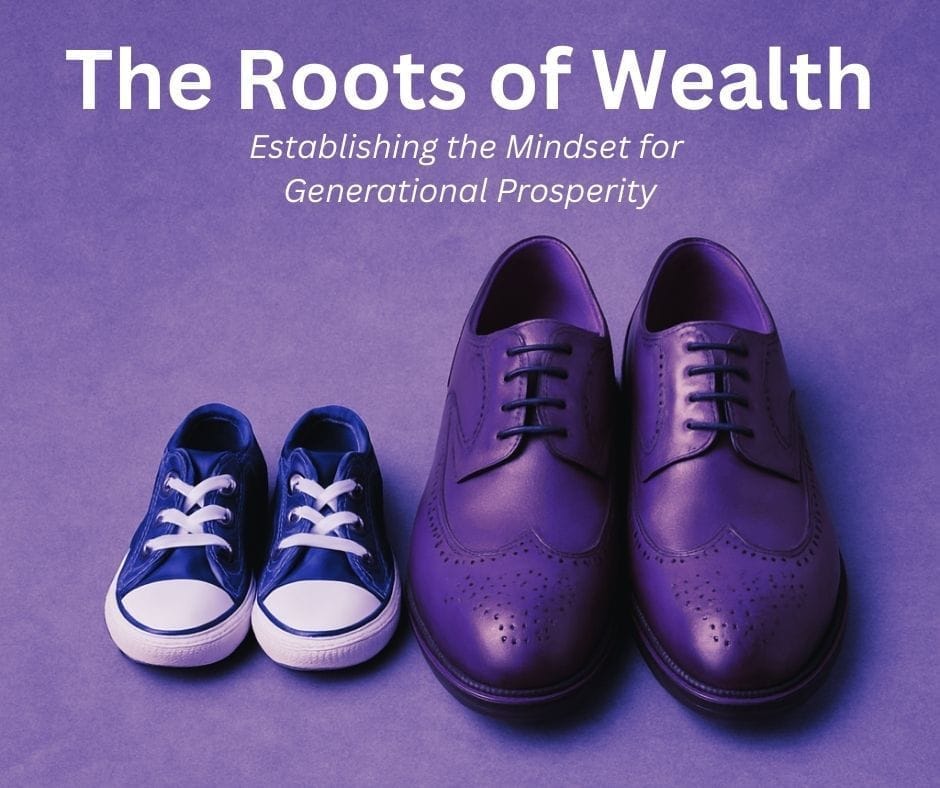
This is why I created The Roots of Wealth, a six-part self-paced course for parents.
The course is not simply about earning more money. It focuses on identifying and challenging the deeper beliefs that shape financial behaviour in families.
Many limiting beliefs are not created in adulthood. They are inherited, often unconsciously, from previous generations. Without awareness, they continue to shape decisions long after they have stopped being questioned.
When families begin to recognise and challenge these patterns, they create space for something different to emerge: greater responsibility, clearer thinking and more intentional financial behaviour.
Changing Financial Outcomes
Starts at Home
Not every circumstance is fair. Not every person begins from the same starting point. Those realities should never be ignored, but acknowledging complexity does not remove personal responsibility. In many cases, it restores it.
When people understand that choices matter, they also begin to see that change is possible.
Children who learn this early are more likely to become resilient, adaptable and capable adults. They stop waiting for rescue and begin looking for ways to create value, solve problems and build something meaningful.
That shift changes everything.
The roots of poverty and the roots of wealth often begin long before bank accounts are involved. They begin in the mind, in the home and in the daily decisions families make over time.
A poverty mindset is a set of beliefs and thought patterns that shape how a person views money, opportunity and responsibility. It often includes the belief that success is limited, external forces control outcomes or that wealth is only for “other people.” These beliefs influence financial behaviour long before income levels change.
A poverty mindset is often shaped in childhood through environment, language and observed behaviour around money. Children absorb attitudes from how parents talk about finances, stress about money or respond to financial challenges. Over time, these messages become internal beliefs that influence adult decision-making.
Yes, a poverty mindset can be changed when a person becomes aware of the beliefs shaping their behaviour. Change happens by challenging limiting assumptions and replacing them with more constructive ways of thinking about money, responsibility and opportunity. Consistent new habits and thinking patterns can gradually reshape financial outcomes.
Generational poverty refers to a cycle where financial struggle continues across multiple generations within a family. It is often linked not only to income levels but also to patterns of thinking, behaviour and decision-making around money, education and opportunity. These patterns are passed down through family culture and environment.
The cycle of generational poverty is broken by changing both behaviour and mindset within a family system. This includes developing new financial habits, encouraging responsibility and shifting beliefs about money and opportunity. Over time, small consistent changes in thinking and action can reshape outcomes for the next generation.
Mindset influences how a person responds to opportunity, risk, discipline and long-term planning. A constructive financial mindset encourages responsibility, problem-solving and delayed gratification, while a limiting mindset may reinforce avoidance or dependency. Over time, these thought patterns directly shape financial decisions and outcomes.


Stay fired up for success with Shirley's
Entrepreneur Newsletter
Raising Job Creators
Keep up the momentum of building your family's financial education.
Don't lose your drive to take small daily steps to reach for big dreams.
Your privacy is secure.
You can opt-out anytime.
Categories
Raising Job Creators Newsletter
Subscribe to the newsletter and stay fired up for success! By joining, you acknowledge that you'll receive Shirley's newsletter. You can opt-out anytime hassle-free.
Copyright © 2025-2026. Shirley Erwee. All Rights Reserved
Created with ©systeme.io